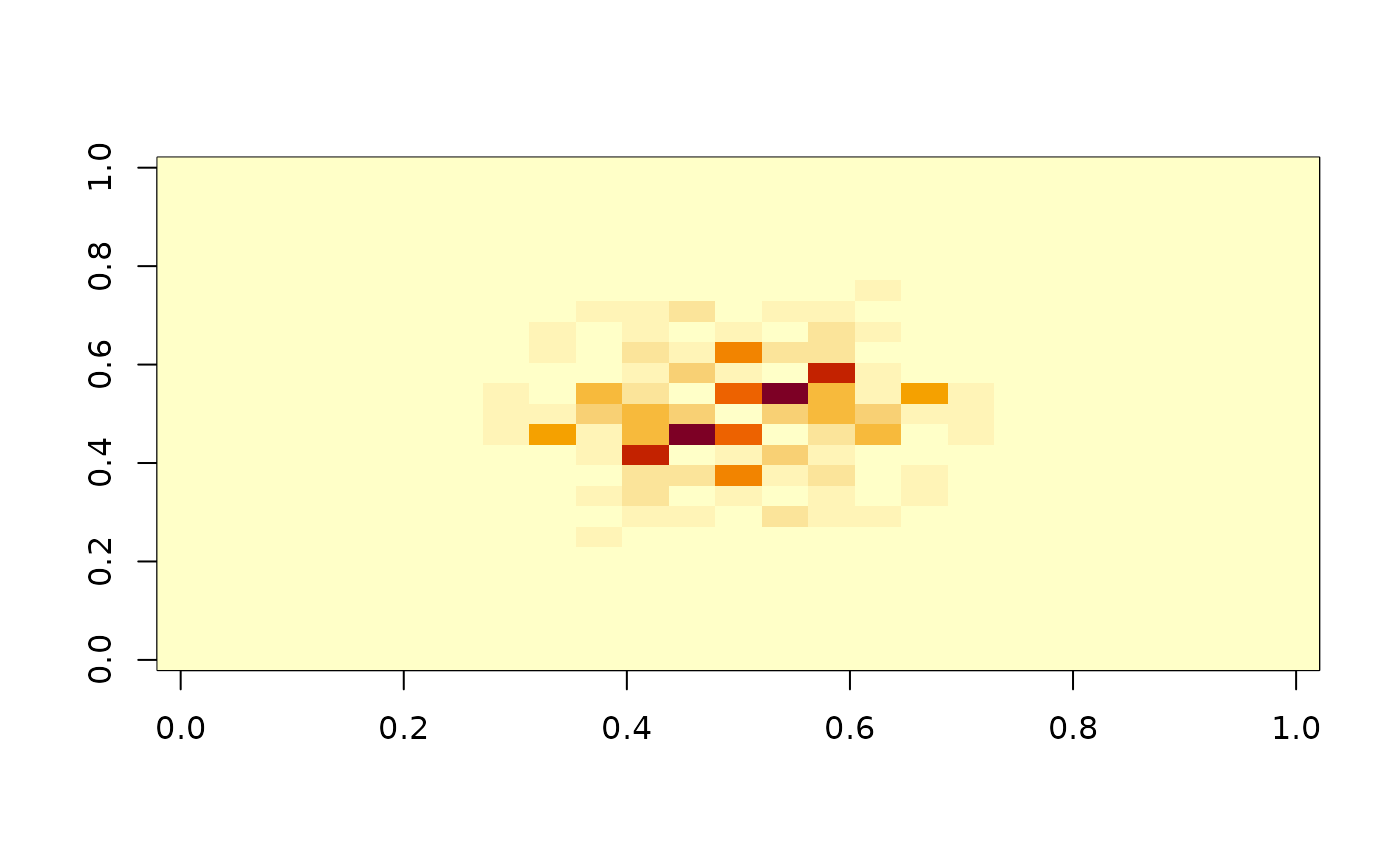
2D Periodogramm
I.RdComputes 2D Periodogramm. Consider the discrete Fourier transform of the sample: $$J({\omega}) = \frac{1}{\sqrt{2\pi NM}} \sum_{s\in S} x(s)\,\exp\!\left(-i\langle s,{\omega}\rangle\right)$$
Then the 2D periodogram is given by: $$I(\omega_{kl}) = J(\omega_{kl})\,\overline{J(\omega_{kl})} = \big|J(\omega_{kl})\big|^2$$
Examples
x <- gridMA(25, 25, MA_coef_all(.7))
image(I(x))